Unlocking the Power of Full Matrix Capture (FMC): From Amplitude-Based TFM to Phase Coherence Imaging (PCI)
 Instructor-Led Training
Learn how Full Matrix Capture (FMC), Total Focusing Method (TFM), and Phase Coherence Imaging (PCI) enhance ultrasonic inspections through improved resolution, flaw characterization, and practical application guidance.
Member: $450


Credit Info
- Contact Hours: 4
- IACET CEUs: N/A
- Valid for ASNT Level III recertification: Yes
- Renewal Category: B
Course Overview
Full Matrix Capture (FMC) is revolutionizing ultrasonic testing by enabling advanced post-processing techniques that go far beyond conventional phased array inspections. This 4-hour short course provides a comprehensive introduction to FMC and its key imaging modalities—Total Focusing Method (TFM) and Phase Coherence Imaging (PCI)—to help participants fully understand their practical benefits, technical considerations, and application potential.
This course is ideal for inspectors, engineers, and technicians who want to deepen their understanding of FMC-based imaging and understand the benefits of one method over the other.
Upon Completion, Learners Will Be Able To:
- Explain the principles of Full Matrix Capture (FMC) data acquisition and its advantages over conventional phased array techniques
- Describe the fundamentals of amplitude-based Total Focusing Method (TFM), including how focal laws are applied to generate high-resolution images
- Identify key factors that influence TFM image quality, such as coverage, aperture, and resolution
- Summarize the core concepts behind Phase Coherence Imaging (PCI) and how it differs from amplitude-based methods
- Compare the capabilities and limitations of TFM and PCI in detecting flaws and improving signal-to-noise ratios, particularly in challenging inspection scenarios
- Interpret sample inspection data using both TFM and PCI to evaluate their practical performance in welds, complex geometries, and noisy materials
- Apply best practices for FMC-based inspections, including system setup, scan planning, and image interpretation
- Evaluate which imaging modality, TFM or PCI, is best suited for specific inspection applications
Meet the Instructors
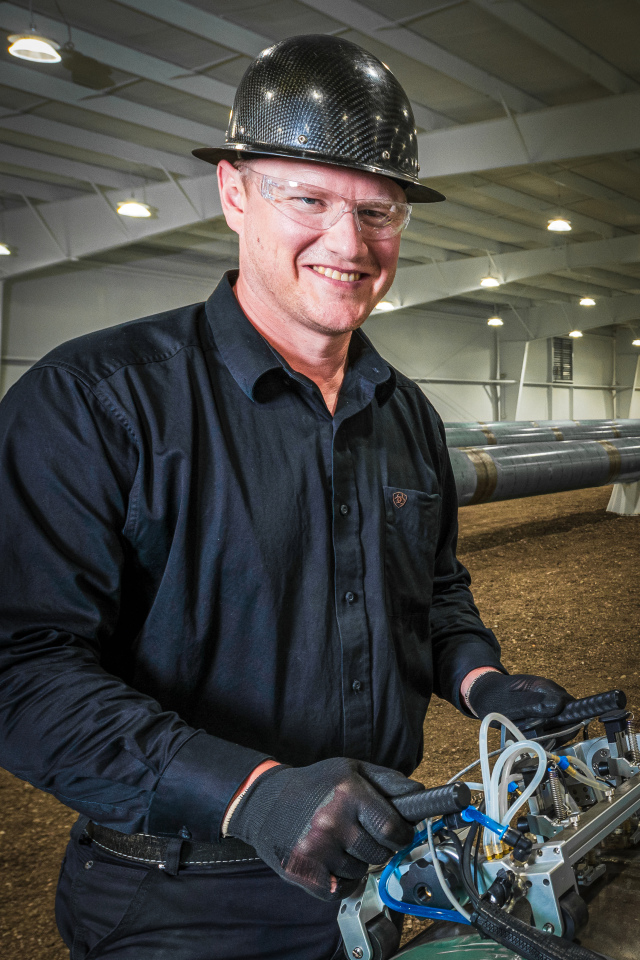
Mark Baldwin
Mark has worked in the NDT industry since 2009. He holds an Associates of Applied Science Degree in NDT and is trained in accordance with SNT TC 1a in all major NDT methods (VT, PT, MT, RT, ET and UT). Mark worked in the downstream oil and gas industry for 13 years as an advanced phased array QA inspector holding API-QUTE, API-QUPA, API-QUSEPA and ASNT UT Level-III certifications. Mark joined Evident in 2022 as a Sr. Application Engineer where he supports business development, technical support, training and application solutions.

Jay Norman
Jay joined the Evident application team in Webster, TX in 2024, bringing over 15 years of NDT experience. Trained at Ocean Corp., he began his career with Acuren and later HMT, specializing in advanced ultrasonics within the oil and gas sector. He holds API-QUPA, API-570, and Level II Buried Pipe Guided Wave certifications, with expertise in phased array weld inspection, corrosion mapping, and guided wave testing. Known for his technical skill and commitment to quality, Jay delivers reliable inspection solutions and is a valued member of the Evident team.